Sunday, November 11, 2012

Beer Sheva II


Beer Sheva is a hodge podge of architectural styles. There are run down areas of urban decay, dreary blocks straight out of the post-war east European style of mass public housing. Other older tower blocks have been renovated and beautified, their gardens well tended. In between are neighbourhoods of private homes, a child's drawing of a simple white house with a red roof or Mid East style boxes with wrought iron gates and enclosed courtyards.


Only the swish modern buildings are built according to the post-1991 Gulf War construction codes that require homes to each have their own personal "secure room" shelter. For everyone else a siren means either a mad dash to an outside shelter or holing up in whichever room has the fewest windows or external walls.


I always take lots of photos from my wanderings around Israel for our friends and family abroad, many of whom I know have never visited Israel or have done so only briefly. My photos from Beer Sheva are nothing earth shattering - a street view, historical site, a park, a couple of museums.


Stormclouds over scrub and farmland on the outskirts of Beer Sheva

When (if) you see reports of southern Israel coming under rocket fire, this is what those reports mean, just ordinary places you might live or visit, except that every so often, way too often, the folks in Gaza lob rockets at them.


To me it is walking around the very ordinariness of a place like Beer Sheva on a quiet day without sirens that truly brings home the craziness of the situation. Just walking in the park or praying in the synagogue or enjoying a family dinner with friends and thinking that any minute the peace might be shattered by the eerie sirens of my mother's childhood in wartime London. It boggles the mind.


Waiting for rain in the countryside around Beer Sheva


One of several beautifully planned play and recreation areas at the Australian cavalry memorial park in Beer Sheva. This sign reminds visitors of the rules of the park including no eating of sunflower seeds in the playground and respectfully waiting one's turn on the play equipment.


Soldiers from Australia and New Zealand played a pivotal role in the British fight against the Ottoman Empire during the First World War. Perhaps their most famous battle was the Beer Sheva cavalry charge, one of the last in history.


The Joe Alon Bedouin Heritage Centre in the Lahav Forest just north of Beer Sheva offers an insight into the traditional lifestyle of the Bedouin tribes of the Negev and Sinai, employing local Bedouin to guide visitors.

Beer Sheva


This past weekend we were down south visiting some dear friends in Beer Sheva.


I took the train down on Thursday so that my aircraft mad kids could spend the afternoon at the nearby Air Force Museum. They spent a good couple of hours racing around the outdoor exhibits and calling out the names of the ones they recognised, but I think the highlight was

scrambling on the old trainers with open cockpits strategically placed near the indoor museum so that visitors can get that urge to climb on something out of their system before going on to the collection of historic aircraft with the big "do not touch" signs.


That evening we went on to Beer Sheva itself, dropped the kids off at our friends' flat with a babysitter while the four of us grown-ups went out for dinner at a modest studenty little Indian vegetarian place.


Friday dawned grey and overcast, a first real hint of winter. Still it wasn't too chilly so our host took us to a nearby park, built as a memorial to the Australian cavalry who fought for the British in the First World War and played a crucial role in defeating the Ottoman Turkish army. Aside from the memorial there is a lovely park and several fun playgrounds for children of all ages. A perfect blend of history and energy burning excitement for the kids.

As the rain clouds grew more ominous we headed to the Joe Alon Bedouin Heritage Centre, a museum showcasing traditional Bedouin life in the Negev and Sinai. The children were absolutely riveted, impressed by the skill with which the Bedouin mastered their harsh environment and the resourcefulness with which they made what they needed from what was to hand, from weaving baskets and shelters from palm fronds to recycling tin cans and bottle tops to make toys.


There was even a mini traditional Bedouin tent for the children to play in, and the kids got to work, inspired by what they had seen in the exhibits, pretending to grind wheat and bake pita, weave goat hair for their tent walls and pound coffee beans the traditional way. Our local Bedouin guide seemed chuffed by how they got into the spirit of things and taught them the special rythymn for pounding coffee along with a generous dose of folk tales.


We enjoyed a beautiful Shabbat in our friends' Beer Sheva community, visiting their shul, meeting families from the neighbourhood, the children playing happily together. The afternoon's excitement was seeing a bevy of horses going by, some local teenagers out for an afternoon ride on the usually busy main road, almost devoid of traffic in the lull of Shabbat.

And on the drive home we heard on the radio about the escalation in rocket fire on southern Israel from Gaza.


Over the last day or so around 90 rockets have been fired into southern Israel. Their range includes the small farms and villages close to the Gaza border, coastal cities like Ashkelon and Ashdod, all the way up to towns like Gedera and Yavneh, commuting distance from Tel Aviv.


Two of those rockets fired today targeted Beer Sheva and the sirens once again wailed over the city sending residents to seek cover wherever they could.


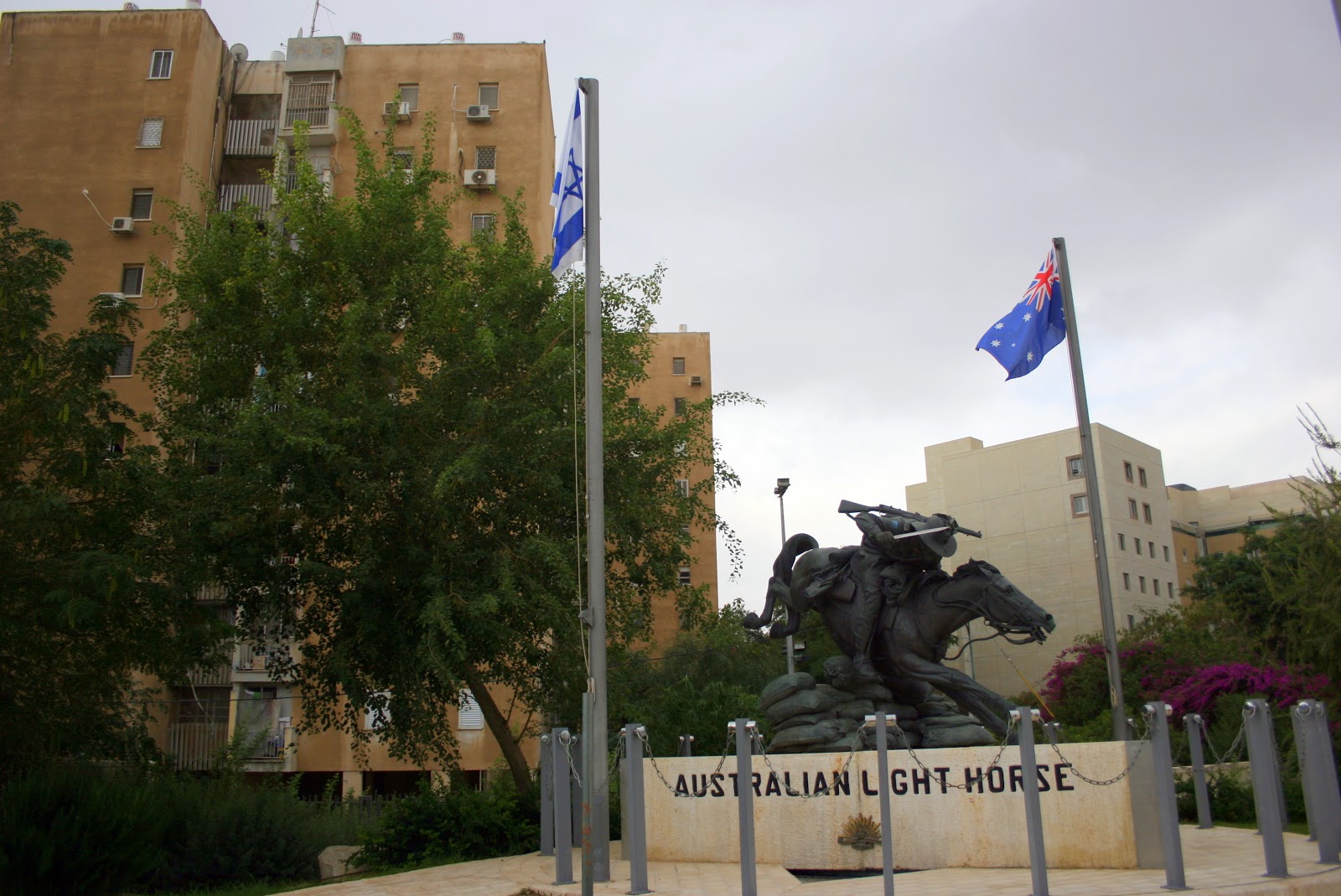
First World War Australian cavalry memorial with typical Beer Sheva blocks of flats 

Thursday, October 11, 2012

Pomegranate season


"Ima, do you know how I feel when I eat this wonderful ruby pomegranate? I feel like a great princess who gets to dine on fine delicacies every day. I feel beautiful with the beauty of this queen of pomegranates."

That was J waxing lyrical about this evening's dessert. She got through one and a half whole pomegranates by herself, the kind that look ugly and beat up and dried out on the outside to the extent that you are almost tempted to discard them as past their prime but when you open them you find them a delightful juicy ruby on the inside and so full of flavour, so perfect that they are gobbled up in minutes.

It's funny to me to see the current fad in the world for pomegranates, as though they are something new, just discovered rather than a key fruit central to the cultures of some of the world's most ancient civilisations.
Of course we have grown up with pomegranates, a lifelong favourite of mine be they tart, sweet or somewhere in between. As my one of my mother's English friends used to call them "those funny red things that Jews and Iranians eat". Quite.

Thursday, July 05, 2012

חתונה מאוחרת...


יום של צער ושמחה מעורבים, הבשורה על מות בעלה של חברה ואח"כ חתונה. 

חתונה מאד מעורבת: חרדים וחילונים ומה שביניהם, חוזרים בתשובה ועונים בשאלה וכולם בתוך משפחה אחת, אחים ואחיות והורים וילדים. אני לא יודעת אם זה כך אצל כולם, אבל נדמה לי שאנחנו מגיעים להרבה אירועים כאלה שמכנסים לתוכם כל מיני קצוות של החברה שלנו, רוב הזמן תוך משפחה אחת שחבריה בחרו בדרכים כ"כ שונות. אז אולי עמנו אינו כה מפולג כפי שמייצגים אותה 
בתקשורת או אולי פשוט נפלנו על אחרית הימים, וכמו בחתונה בה השתתפנו הלילה משפחה חרדית תתחתן במשפחה חילונית ורב חובש כיפה סרוגה תערוך להן חופה.

Sunday, March 11, 2012

Sky rockets in flight

Imagine being all excited about your 6th birthday party.

You've been planning for months. Your birthday is around Purim time so you're planning a fancy dress party. Your costume is chosen and ready. Your cake is baked. Your mother has bought all kinds of goodies your health conscious family doesn't usually have in the house.

You've invited friends from all around Israel. You're excited to show them your kibbutz with it's cow shed full of black and white cows. You're very proud of "your" cows.

You're counting down the time left until your party, only just over a day to go.

And then rockets start raining down on southern Israel, air raid sirens blaring night and day sending you and your family and your neighbours scurrying for cover with only seconds to spare. Your mother announces, sorry sweetie, it's just too dangerous to have your party here right now, we can't invite people to our home, it isn't safe.

My own 6 year-old, J, was supposed to be going to A's costume party. She too was all excited, anticipating the games and of course, the thrill of real live cows in the barn.

Only A lives in a kibbutz within rocket range of Gaza and as of Saturday night over 100 rockets had been fired into Israel, the residents of the region staying close to their shelters.

Saturday night we got a call from little A's mother telling us that for the third time in about a year she's had to tell guests not to visit because of the "security situation". This is the third time J was meant to go down to A's southern kibbutz and A's mother has had to cancel because of rocket fire from Gaza into Israel.

Poor A as you can imagine was disappointed. And worried about the cows that don't have a shelter like the people do.

Luckily her mother is a resourceful woman and on short notice she figured out that the birthday party could be relocated to parkland just north of their kibbutz, an area still out of range of the rockets from Gaza.

A got to have her party and host all her friends from around Israel. They had a treasure hunt in the woods and pass the parcel, then her big brother did a magic show followed by a feast of falafel, hummous, pita and salad, chips, Bamba (peanut butter puffs - Israel's national kids' snack) and a chocolate crisped rice birthday cake.

J came home bouncing and happy, excited by the surprise location of A's birthday party and by the little individual packs of candy each child received - there were SO many flavours to choose from!

She also came home chattering about all clear signals, sirens, clearing up unexploded bombs and the dangers of unexploded ordinance.

Try as one might, you can't shield the kids from this, even if they aren't in areas directly affected by the rockets. J knows that her friends to the south of us have to live with air raids. She knows that there is a chance that one day we might be in range too. She knows what to do during drills.

After today she also knows first hand from A and other kibbutz children what it's really like, what the adults warn the children to be careful of (if you find bits of shrapnel or exploded rocket when you're out playing don't touch!) and what they do if the siren catches them outdoors or in the car.

I can see that to some extent she is anxious about it all, a little scared, but mostly she is matter of fact, practical and accepting. This is just the way things are. This is the way A has grown up, and for J it's as straight forward as that. Rocket attacks are to her and A as much a force of nature as the theoretical earthquakes we drill for too.

Sunday, March 04, 2012

Hamentaschen recipe


 It's that time of year again, stores are chock full of garish costumes and face paint, DH is practicing his theatrical Megilla reading and every evening our peace is disturbed by teenagers throwing firecrackers in the park late at night. Purim must be coming!

Our multitudinous local bakeries have been selling hamentaschen since the day after Hannukah, and as with the Hannukah sufganiyot every year sees new attempts to out do the competition with unusual and bizarre hamentasch flavours.

Our family custom is to make our own, for the younger generation it is one of the highlights of the month of Adar, and just like  the bakeries, we seem to experiment with new fillings each Purim. One thing remains constant though, our basic hamentasch recipe.

"My" recipe is based on my mother-in-law's white flour recipe which I adapted for wholewheat, and just because I can't help tinkering with recipes. What I love about this recipe is that it is simple and kid, even toddler, friendly, so it's fun and easy to turn hamentaschen making into a family project.


Wholewheat hamentaschen dough

2 eggs
1/2 cup olive oil
Juice of one orange (about 1/2 cup)
2 tsp vanilla
1/2 cup demarara (light brown) sugar
2 tsp baking powder
1/4 tsp salt
2 3/4 cup wholewheat flour + a little more


Choose a filling of your choice for example a jam of some sort (we like the whole fruit kind), brownie mixture, chocolate chips, dried fruits, dulce de leche, poppy seed, pie filling, English mince pie filling, halva spread, peanut butter, carob spread or even soft cheese with cinnamon.

Preheat oven to 180C or about 350F
1. Mix wet ingredients
2. Add dry ingredients and knead. (If the dough is sticky rather than smooth and easy to work with gradually add a little more flour to the mixture in handfull increments, until the dough has a smooth, non-sticky texture and is easy to shape.)
3. Take a pinch of dough. Roll into a ball and then flatten into a circle. You can take a small pinch to make mini-hamentashen or a largish pinch to make them big, whatever size works for you.
4. Fill with jam or other filling of your choice
5. Fold over the filling and pinch into a triangle shape
6. Do not grease pans
7. Bake at 350 F (about 180C) for around 15 minutes (check after 10)

NB If you're using wholewheat flour this will come out looking darker than with white flour.

Variations:
a) Mix in some cocoa powder with the flour, even substitute as much as 1/4 cup cocoa powder to the dough.
b) Dilute the orange juice with liquor such as Baileys or other Irish cream, creme de menthe, rum, chocolate or coffee liquor.
c) Replace the vanilla extract with peppermint extract, works especially well with chocolate filling and with added cocoa powder in the dough.


Chocolate hamentasch filling

@250gr dark or bittersweet chocolate
3 tbl oil or softened butter
2/3 cup wholewheat flour
1 tsp baking powder
1/4 tsp salt
2 eggs
2 tsp peppermint extract or vanilla extract
2 tsp coffee
3/4 sugar
3/4 cup dark chocolate chips

1. In a microwave proof bowl melt the chocolate, taking care that it doesn't burn. Try it in small increments, the exact time needed will vary according to different power microwaves.
2. Mix in all the rest of the ingredients except for the chocolate chips.
3. Fold in the chocolate chips.
4. Fill hamentaschen (dough recipe above, I usually add cocoa powder to the dough). You will need to work fast as the filling will stiffen and harden as it cools.

Any left over filling can be used to make chocolate drop cookies, bake for about 10 minutes on 180C.

Wednesday, February 08, 2012

Tu B'Shvat


So we didn't do anything too exciting for Tu B'Shvat, but we did have a great walk on a hill near our home. Almond trees are not at their peak yet, aside from one tree, many cyclamen are yet to open, but the crown anemones are glorious, plenty of Land of Israel iris, wood sorrel and Dominican sage, asphodels starting to bloom in patches, some spring groundsel and pimpernels, start of the wild mustard, chamomile and several other flowers we usually see slightly later in the season and even a few early green ears of barley. Plenty to feast the eyes and senses on.


I've been walking over this hill for so many years, observing it in all seasons and weathers, but exploring with my kids is like seeing everything anew. I'm still the crazy lady lying belly down in the mud trying to capture just the right angle for a cyclamen portrait or a shot of an interesting clump of anemones, but now I have J and T getting down on the ground with me and noticing an ant or a grasshopper hiding in the grass, or spotting a tiny unfamliar wildflower I might not have seen otherwise. And sometimes as I'm trying to get my photograph T will climb on my back or J will lean over and block the light, but that's part of the fun of it, they want to learn everything from what each flower is called to why I need to twist in convoluted contortions to shoot a picture of a flower.


Their boundless curiosity forces me to keep learning too, whether it's recalling long forgotten classes in geology or history, or looking up botanical facts, I have endless questions to answer. Even T is now old enough to be able to ask questions, albeit usually of the one or two word variety. He has graduated from being a "she-eino yodea lishol" (one who doesn't know how to ask) to a "tam" (one who asks simple or naive questions).

J is often the one who rushes to answer these days, she is so excited to have a little brother to teach. The two of them enjoy exploring the hill together, J sometimes leading him along by the hand, pausing to point out items of interest, crouching down with him to inspect a patch of lichen or teach him the parts of a flower. I have no idea what T is absorbing from all this at his tender age, but he laps it up, thrilled when he recognises a flower he's learnt about, questioning if another yellow flower is the same as the one next to it.


The highlights of our Tu B'Shvat walk were definitely the butterflies though - a painted lady and a green-striped white. I gave J our pocket butterfly field guide and she sat on the ground and opened it up, pointing out the different insects to T and trying to figure out which was posing for us on the path. Then the painted lady led us a game of chase around some of the prickly pear cactuses the kids trying to trace its erratic path, giggling in delight when it swooped low over them.

It wasn't all nature lessons though. Our region is blessed with an abundance of archaeological sites - ruins from Crusader, Byzantine, Roman, Second and First Temple periods, and earlier. The earth is littered with shards of pottery and the entire hill is covered in ancient cisterns, now thankfully gated over for safety. Little T who barely talks in sentences recognises ancient olive presses and excitedly yells out the Hebrew "beit bud, beit bud!" whenever he sees one or anything resembling one. J points out the difference between the large rectangular stones typical of the Second Temple or Roman periods, and the smaller, uneven stones used in later construction, such as the upper section of the Crusader ruin atop the hill. We carefully peer down into an ancient mikva (ritual bath) and note the remains of plastering on its walls.


To be sure we are a family addicted to books, watchers of documentaries and regular visitors to museums, but here, in our own backyard all of that truly becomes real and tangible. My oldest thrives on the theoretical, but out here she learns what books and films and museums just can't quite teach.

Our little local hill is truly their classroom.