Tuesday, August 30, 2022

Nostalgia


You would think wouldn't be surprised by now, coming around the corner on the 18 bus and seeing the circus tent, fairy lights, go carts and carousel of the First Station leisure complex. I should be used to it but somehow it still surprises me every time more than two decades after the station shut to trains. 

It's certainly a cool place to hang out these days. You can find everything from traditional Middle Eastern grill and hummous to Italian to creperies to east Asian fusion to smoothie bars to burgers to boutique beer breweries and chic bars, from super duper Mehadrin kosher certification to none at all and open on Shabbat.

On an August night it is crowded with locals and tourists alike, restaurant tables spilling out on to the cobbles and decks which were once track and platforms.

The "First Station", the original late 19th century Jerusalem train station built when the region was part of the Turkish Empire, later expanded during the period of British rule, a mix of Ottoman and British colonial styles. 


I have fond childhood memories of this place, back when it was actually the Jerusalem train station within walking distance of the historic walls of the Old City. I remember as a little girl taking the train from Tel Aviv to Jerusalem with my mother.

Back then it was a sleepy old railway line, lazily chugging its way up from the coastal plain, slowing even more as it began to wend its way through the foothills and then mountain passes climbing up to the Israeli capital. How slow was the train? Jokes ran the gammut of you'ed get there faster on a camel, a donkey or even on foot. It was faster to take the bus. 

For all its inefficiency, ancient rolling stock, uncomfortable seats and snail's pace though it was a charming line, especially the section from Beit Shemesh to the Jerusalem central station, which passed through some of the most beautiful mountain scenery, the Sorek stream, pine forests. And it did so so slowly that you had time to appreciate the view, snap a few photos (if the windows weren't too smudged) and enjoy the journey.


But in the late 1990s it was decided that having a noisy, smelly, dirty diesel train route going through the heart of the city was not such a great idea. The city's station was moved to the more industrial outskirts and the beautiful Ottoman era stone station was turned in to a leisure area with bars, restaurants and entertainment along the old track, waiting rooms and even signal box. The section of track running through prime residential neighbourhoods became an urban park, beloved today of runners, cyclists and parents pushing prams and pushchairs. 

First Station today is a fun, happening, recreation area but part of me still misses the old working station. There was something magical about pulling in to the heart of the city, right in the middle of everything, a short walk from some of the most iconic Jerusalem sights, including the majestic walls of the Old City. When the train arrived at that station you really felt that you were in historic Jerusalem.

Sitting in the bustling modern leisure district tonight I closed my eyes and thought back on those memories. The summer throngs melted in to late 20th century travellers and in the thumping beat of 21st century electronica wafting along from a nearby bar I could imagine the clickety clack of the rails, the vibrating rattle and whine of a gritty engine, a hint of diesel on the night breeze, the sweet-tart taste of a freshly squeezed orange juice from the old time station kiosk.


Saturday, April 02, 2022

Lizard soap operas and myna dramas


It was a perfect Shabbat for the garden, the spring weather bringing out a flurry of activity among its varied residents.

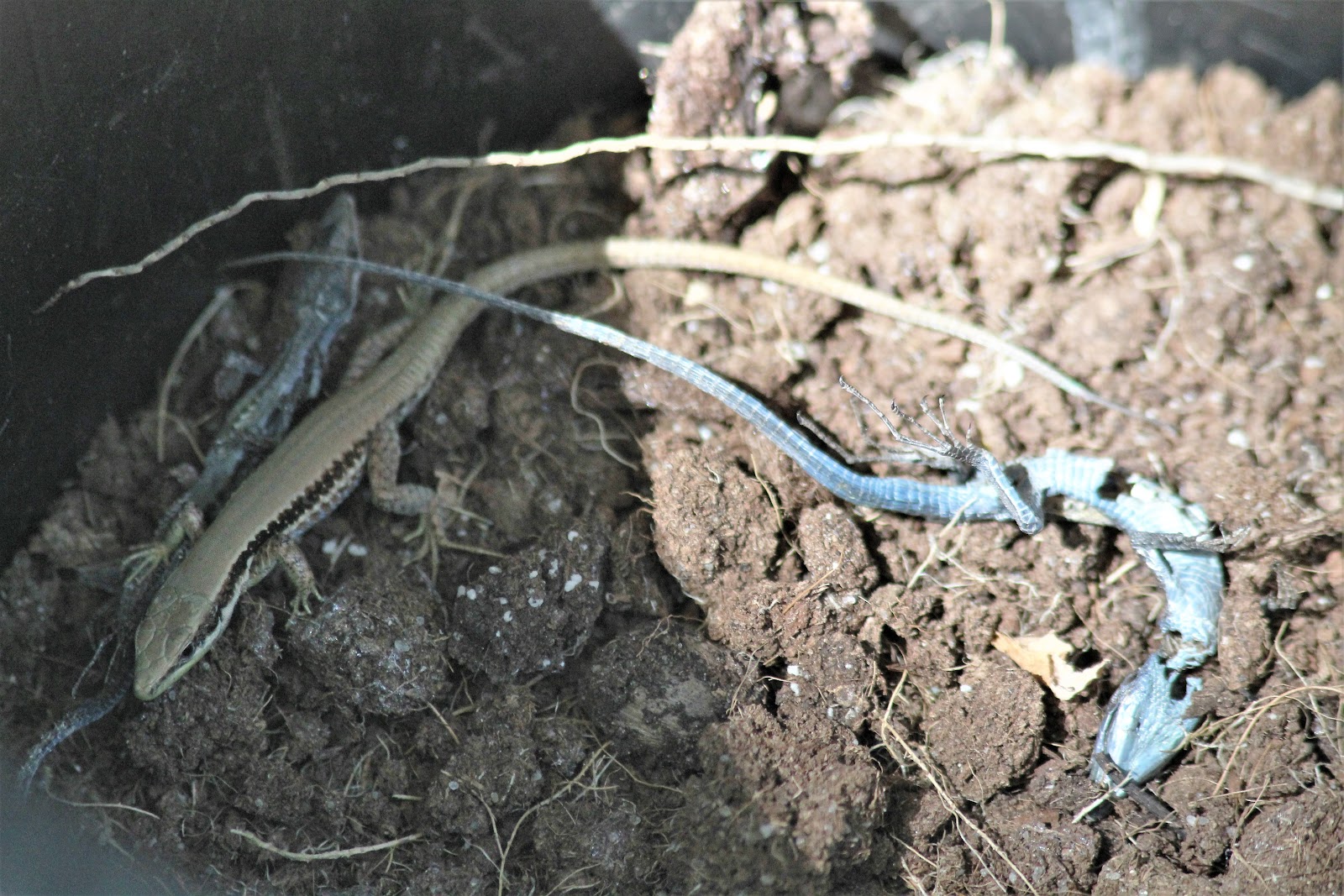
The liittle boys arranged plastic chairs in the middle and we enjoyed a mellow couple of hours watching our local soap opera played out by the Lebanon lizards who live on and in the wall, using the surrounding trees and bushes as their playground.

"Shhhh!" Twin H admonished Mid Bro in a theatrical whisper "you''ll scare them away and then we'll have no one to watch."

Then he resumed his studious, quiet observation of the wall's denizens as they darted and climbed over and between its uneven stone cladding.

"Ahhh" they'd all give a collective gasp when the dominant blue headed male chased a wayward little lizard along the top of the high wall, and at some stage the little guy would admit defeat and drop off the wall in to a bush or the herb border, pick itself up, and steathily resume its climb up the wall, cautiously, in the shade of a bush or sneaking from crack to crevice.


At some point the resident agama lizard made an appearance, a mini-dinosaur of dark armour and spines in contrast with the sleek, brightly coloured graceful Lebanon lizards we more commonly see.

He was a giant by comparison but was content to enjoy his sunny spot on the wall, basking in the warmth which had at long last made an appearance after a frigid March.


He paid no heed to the antics of the smaller lizards with whom he shared the wall, ignoring them as a resigned, experienced older patriarch might the excited banter of his young progeny.


The little boys resorted to hand signals to draw attention to any new creature making an appearance. Look right and over the lemon tree, down among the purple flowers of the lavender, up top near the abundunt citrus trees of our neighbour. Remember when the wind blew oranges and clementines off their tree in to our garden? They tasted so good.

From time to time the show was interrupted by a surprise new comer, and a rustle of excitement swept over the human audience:

A honey bee industriously working on the lavender blooms

A butterfly flitting lazily around the African iris (dietes bicolour)


A coal hued male blackbird feasting on worms pulled from the compost pile.

Determined ants from the anthill in an earthy corner going about their regimented ant business.

An oblivious young jay swooping down on to the ground right in front of us, intent on finding a quiet spot to devour its contraband peanut pilfered from a neighbour's bird feeder.

Doves, sparrows and crows nipping at the fragile twigs of tall trees in search of nesting materials.

A kestrel hovering in the sky hunting for its lunch.

Migratory Alpine swifts zooming and wheeling like a Battle of Britain dogfight as they pursued flying insects.

The hysterial cacophony of the pesky myna birds up on a neighbour's rooftop planters or feuding amongst themselves in the Queensland bottle tree.

It was this last that made Twin H look up from his studious observation of the wall to see if perhaps an even more interesting drama was unfolding high above.

You never know with mynas. We've seen them try (and sometimes succeed) stealing other birds' eggs from their nests. Seen a mother laughing dove fight a pitched battle with a myna to save her brood from a myna brigand. A pair of crows, themselves capable bullies, make a stand against these aggressive intruders.

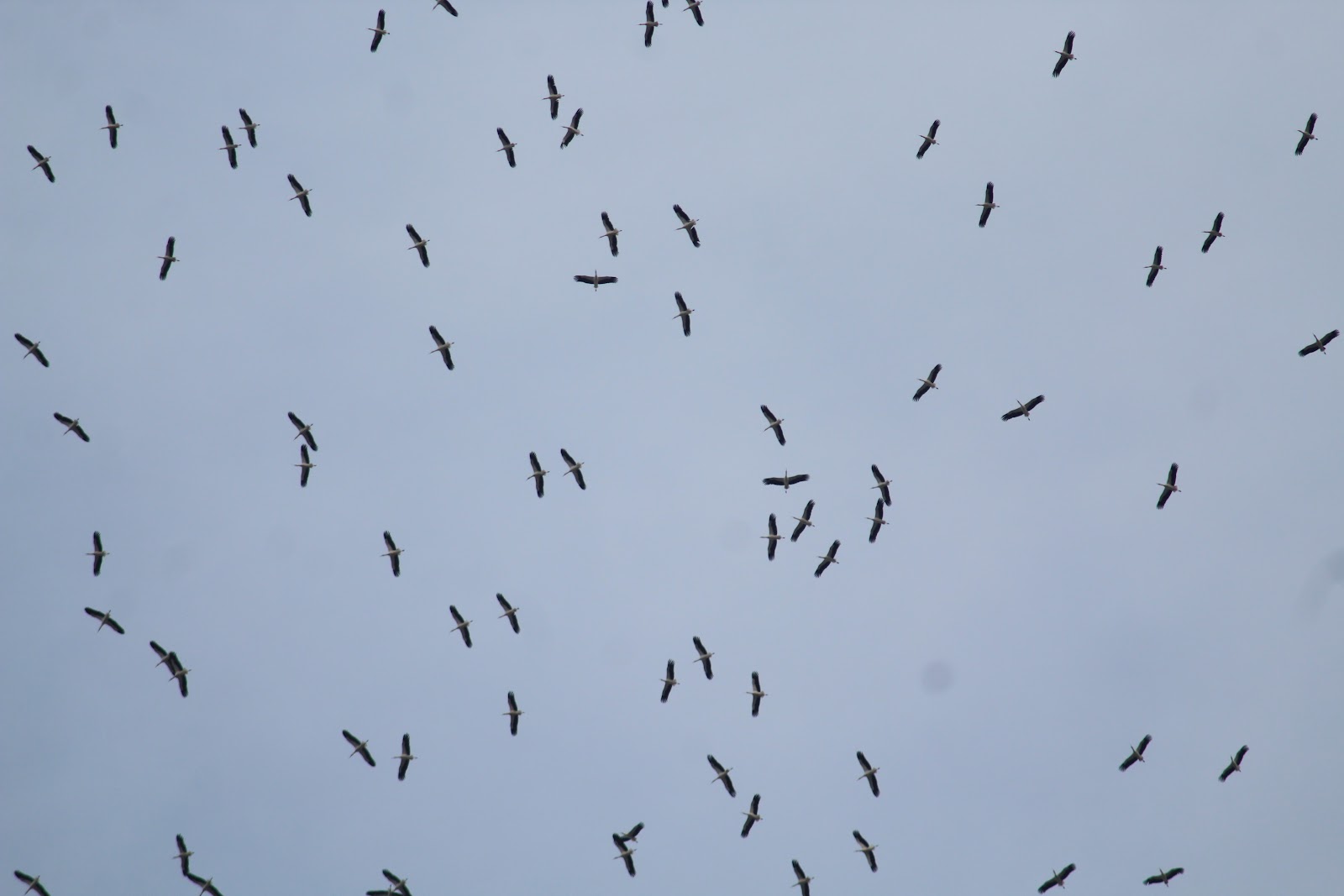
I turned my eyes up to, scanning above the tree for good measure and there they were in the hazy, blue spring skies: a small posse of migrating storks gently milling about in the thermals, the advance guard of a huge flock still mostly specks in the distance.

Not as close and impressive in numbers as the one's I'd seen Friday lunchtime, but thrilling enough, a majestic wave of the massive avian armada that fills our skies this time of year.

They are heading north to their summer breeding grounds as they do every year, only a handful will stay to nest in northern Israel. The rest will keep on until they cross over in to Europe, confident that as every summer they will find their roosting sites as they left them, unaware of war and avian flu. 

There seems to be no bird grapevine giving them advance warning that things in their summer home may not be what they expect. Some are heading for Lithuania, Latvia, the lands of the Baltic Sea, maybe some also to Poland, Romania.

Most though are returning to Russia and Ukraine. Who knows what awaits them there. 

The little boys call out to the storks sotto voce "take the people in the north shalom and sunshine from Israel!"


Wednesday, March 30, 2022

I get a lot of questions about Israel, people want simple one sentence answers, good, bad, black, white, in a nutshell.

It's been a diffcult few days in Israel. ISIS affiliated terrorists have attacked and killed 11 Israelis in the cities of Beer Sheva, Hadera and Bnei Brak, the largest number of Israelis killed by terrorists in a week since 2006.

Tonight as Israel grieves the victims of the third terror attack this week, I'm going to simply show you the complexity of Israel and the futility of trying to neatly put everyone in to categories.
Israel's current coalition government includes Ra''am, the Islamist party lead by Mansour Abbas. Abbas, a Muslim Israeli-Arab from the Galilee town of Mughar, is on record for expressing solidarity with the Jewish people for their suffering during the Holocaust and for condmening the attacks on synagogues and the Jewish community in mixed Arab-Jewish Israeli cities such as Lod and Akko last May.

The perpetrators of the attacks in Beer Sheva and Hadera were Arab citizens of Israel, one a Bedouin father of five from the Negev town of Hura, the others from the northern Arab Israeli town of Umm el Fahm.

The man in the photo below is Amir Khoury, the Arab-Israeli police officer who bravely tackled the Palestinian terrorist from Yabed who attacked passers by in Bnei Brak this evening. The terrorist was an Islamist, possibly affiliated in some way with ISIS.

The police officer who succeeded in stopping him was a Christian Arab from Nof Hagalil, a suburb of Nazareth. Sergeant Khoury, though already fatally wounded himself, successfully shot and killed the terrorist, but lost his life doing so. May his memory be blessed.


Thursday, March 17, 2022

Shiny Happy Bagels


We sat down to a light dairy, fish and bagels Purim eve dinner tonight. Straightforward enough easy meal when everyone comes home starving after the public reading of the Book of Esther in synagogue following a day of fasting. Custom is not to break the fast until after hearing the public reading of the Book of Esther.
Among the many cute fancy dress costumes we saw tonight there was one very practical one - a kid dressed up like an old fashioned refreshments seller at a cinema or theatre, except instead of popcorn or chocolate she had individual little bottles of juice and pastries which she handed out to everyone as soon as the reading finished. Smart kid.
Back to our dinner at home though. DH set out the salads and I started cutting open bagels and, well, found this face in the first one that I cut.
Purim prank? Serendipity? Any way this could have been intentional rather than a fluke?

Could not have been any more appropriate timing than on this festival of topsyturvyness.

Wednesday, March 16, 2022

Rewarding Putin's aggression?

Watching the horrific war unleashed on Ukraine one can only pray that peace will be restored soon And yet following the reports of a potential ceasefire deal which may or may not be coming to fruition I can't help but be concerned where it leads and what it might mean for the long term stability and safety of Ukraine and its citizens.

Ukraine is desperate to end the suffering of its people and the destruction of its cities, but this deal offers Putin so much of what he wanted, it feels like giving him a huge reward for starting a war, a prize which down the road will only lead to more bloody Putin aggression against his neighbours. Maybe Ukraine has no choice right now, but what a capitulation to Putin's demands.

Bottom line, it sounds as though this is shaping up to be an imbalanced deal in which Ukraine is forced to make concrete territorial compromises, ceding territories to Russia such as Crimea, Donbass and probably more regions recently conquered by Russian forces, as well as giving up its aspirations to affiliate with Western organisations such as NATO and the EU, in exchange for which Ukraine receives airy "security guarantees" and vague promises from both Russia and NATO members like the US and UK guaranteeing its independence.

Ukraine already went this route in 1994 when the Clinton brokered Budapest Memorandum gave Ukraine guarantees from Russia, the US, and UK, with support from France and China, of its 'sovereignty and territorial integrity" in exchange for Ukraine relinquishing all of its nuclear arsenal to Russia. No, they didn't promise to militarily protect Ukraine's right to sovereignty, but they did pledge to intervene in its internal affairs or violate its sovereignty.

And look how well that worked out.

Tuesday, March 15, 2022

Talking to kids about current events

Many people have asked me how to explain to their children what is happening now in Ukraine. Many are frightened that nuclear war and MAD are imminent, others hear half-truths from friends in school about World War III, the end of civilsation, world famine and more impending disasters.  

Talk to your kids in an age appropriate way, teach them some of the history and background. I think it's also important to explain that in their grandparents' generation the world was brought close to a possible nuclear conflict, for example the Cuban Missile Crisis and the Yom Kippur War, this kind of brinkmanship has happened before surrounding other international conflicts and in the end nuclear war was avoided and the situation deescalated.

While nuclear war or some kind of WWIII is a remote possibility as a result of Russia's invasion of Ukraine, there are many other ways this could be resolved too, for example the ongoing negotiations being mediated by Israel between Russia and Ukraine. Nobody knows of course how this situation will end, but just because there is a worst case scenario doesn't mean there aren't also better ones. Many people are working behind the scenes to find a way for Putin to save face while ending the war and stepping back from the brink.

Explain to them honestly that a war between two major suppliers of the world's raw materials, from grain to fossil fuels, will have an impact on the world economy, cause food to become more expensive or lead to some shortages. I used this as an opportunity to chat with my older children about how markets work, supply and demand, inflation and necessity being the mother of invention. Don't overload with facts or lecture, try to engage with them about where our food comes from for example, what we produce locally, what we import. Try to put the current crisis in context, so that they can approach it in a matter of fact way rather than the hysteria they might be hearing from some media sources or peers.

My children were interested in hearing from elderly relatives who were children at the time of WWII and postwar rationing in Britain and Israel. Rather than frightening them they found it reassuring to know that children still had treats, that food might have been different but their grandparents and great uncles and aunts had good memories of their childhoods. Not that we are expecting rationing today, but it gave them a framework to understand that a long time ago there was upheaval, problems with supply of some foods and their grandparents and people adapted, got through it. 

Uncertainty is hard to deal with, but that is part of life and after the last couple of years we have become experts. People are resiliant, we as Israelis have dealt with many crises and come through them. It is OK to be scared and it is OK to feel stressed from all the uncertainty, it's important to talk and find a broader context and perspective from which to view current events.

Thursday, March 03, 2022

There but for the grace of Iron Dome go we

I suppose it is the most natural thing in the world to look at a crisis somewhere else and translate it in to local terms, that is how we process information, through the prism of our own known and lived experience.

Every time I see the pictures of Ukrainian buildings and homes devastated by Russian rocket strikes my heart breaks for the Ukrainian people and my stomach clenches in the knowledge that there but for Iron Dome that would be us every time those same Grad type rockets are launched from Gaza in to Israel. There but for the grace of Iron Dome and Hashem go we.

Grads are not precision guided missiles, they are a fairly primitive but potentially very destructive weapon, most effective when unleashed in volleys to cover the general vicinity of a target, especially dense population centres, and so make up for their lack of precision.

If enough Grads are fired close together then likely at least one or two will score a direct hit on the actual target. So if say the Russian army wants to hit a local Ukrainian government or communications building, they will launch a salvo of rockets in its general direction, in the process hitting surrounding buildings, infrastructure, anything in that general area, be they civilian homes, schools, shops, hospitals, offices, anything at all. 

This is what makes Grads a terror weapon, their randomness and the way in which they are often deployed in this manner. There is no way to use Grad type rockets for "surgical strikes" or pinpoint targetting. Now translate that to a large city like Kharkiv or Kyiv.

Back in May 2021 when 4000 rockets were fired at Israeli population centres like Ashkelon and Ashdod, that's the damage and casualties we would have suffered without an Iron Dome defence system. We here are still under threat of rockets (and possible Russian capriciousness in Syria), we don't have Iron Dome batteries to spare, but isn't a solid missile defence system something NATO could provide? For anyone with qualms about providing offensive weapons, shouldn't providing a defense against rockets targetting population centres be a priority?