Sunday, March 02, 2008

Ashkelon joins Sderot


Ashkelon is an Israeli city close to my heart. I love the beach there and the antiquities. I have friends I like to visit there. I like the simple, slightly laid back sleepy feel of the place.

Ashkelon is one of Israel's larger cities, population about 120,000 I think. Its southern outskirts are just about in range of Kassam rockets from Gaza, but most of the city has until recently not been within range.

In recent months Palestinian militias in Gaza have successfully used longer range Grad rockets which can hit all of Ashkelon, recently hitting a residential neighbourhood and causing alarm in the city. Over the last few days many more longer range Grad rockets have hit the city, falling in residential areas of the fairly densely populated city.

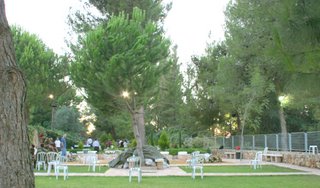
I last visited in late December, and I wanted to post some photos I took there of happier times in the city, before the air raid sirens and Grad rockets.


This bakery in the old town centre serves the most wonderful simple, and cheap local specialties. It also has a palm tree growing through the roof!


Kids adore this whale!


I love walks on the long beach and marina


Wednesday, September 12, 2007

Rosh Hashanah musings in the middle of the night

I don't know what it is about Rosh Hashanah eve, but it seems that all this reflection and awe of the annual Day of Judgement and Remembrance puts me in the mood to write, and seems to give me a little more clarity than usual, well, at least it seems that way at 2am.

I put it down to all the extra time in the kitchen - just me and my thoughts, and a routine of traditional dishes to cook surrounded by sweet spices and honey. My hands do the work while my mind wanders off in a cloud of cinnamon, cloves, cardamom and cumin.

A lot of folks and a lot of cultures relate to the New Year more as a time of partying and celebration, and I guess there is something of that tension in Rosh Hashanah. Yes. it is a festival with special delicious sweet foods, a time for family to be together, a time to welcome the New Year with joy and special treats.

More than that though it is a time for stock taking of the soul, for reflection and sincere soul searching. Not for nothing we blow the shofar, the ram's horn, during the long, extended Rosh Hashanah synagogue services. It's stirring, jarring sound is meant to shake us from the reverie of routine, to remind us that the time is now, Rosh Hashanah is already here, wake up, look within you, make the change, seize the day for new beginnings, for being a better person, for repairing the error of your ways.

This is also a time for forgiveness with no questions asked, a time when we are commanded to go to our friends and family and sincerely apologise for the hurt that each one of us has caused, whether unintentionally or in a rash moment of anger or thoughtlessness. For old friends to renew neglected contacts and those who have feuded or grown apart to seek reconciliation and restore friendships.

Not for nothing is this time in the Jewish year called the Days of Awe (Yamim Noraim). Jewish tradition holds that the world was born on Rosh Hashanah. In the Rosh Hashanah prayer service there is the phrase "Today is the birthday of the world, today all the creatures of the world stand in judgement".

Another traditional Rosh Hashanah prayer describes how all the world is judged by God on this day, passing before Him like sheep, one by one. We pray that all will be inscribed in the book of life, that our good deeds will be found to be as numerous as the seeds of a pomegranate, and yet we know, that as people, we are imperfect, we are not good at suppressing that evil inclination which makes us, even the best and holiest of us, do wrong. And so we also pray that if our merits are in short supply, at least we can fall upon divine mercy.

True repentence, prayer and tzedakah (charity and justice, depending on how one translates it) can help. It is not that they pacify God, it is that they make us better people, make us refocus our lives to fulfill the divine commandments to emulate God's mercy and kindness. That, after all is Rosh Hashanah. To make us take a step back from the humdrum routine and improve ourselves, so that we might do our part to make this troubled world a better place.

God judges us, but the free will that He gave us also means that it is up to us as well, and whether we take the experience of Rosh Hashanah and use it to truly start afresh and make a positive difference in the coming year.

Look back over the last year, cast your gaze around the troubled globe and tremble at how much can happen in 12 months. Look forward and tremble for what may yet come.

There is nothing like living in the Middle East to add extra sincerity and dedication in one's prayers, I imagine that living on the slopes of a volcano might induce a similar degree of piety. A glance at the headlines from the last week of the year is enough to focus anyone's prayers.

Hard to believe that a year has gone by since last summer's war and aftermath. For Israelis, more than ever, it was a year of soul searching, of the Winograd inquiry into the how the war was conducted, of questioning whether we have lost our way, or whether Israeli has lost that spark that has saved our nation time and time again.

A year has passed an still on a national level it seems that things have stood still. The same government is still in office, despite Winograd, despite protests. Kassams continue to rain down on Sderot and the north-west Negev and the government continues to make uncertain noises in response. Tension with Syria remains, a little heightened, but last summer wasn't exactly calm. The tension over Iran's intentions remains. Lebanon still teeters on the brink of more civil unrest. Yes sir, the synagogues should be extra full this year.

And yet, and yet, somehow living on the slopes of the volcano we take all this in our stride. We have faith that somehow we'll work our way out, muddle through, however incompetent our government seems, however much the odds seem to be stacked against us.

May we all be inscribed in the book of life, for health, for happiness and for peace.

Shana tova.

Monday, October 16, 2006

The rains are here - Yippee!!!

Yesterday was the Jewish festival of Shmini Atzeret, the culmination of this month's festive season and the day on which Jews begin praying for rain in the Land of Israel

It was actually rather of striking that the last few days had been a searing sharav, also known as a hamsin, fiercely dry hot weather, characterised by overcast, hazy skies and hot dry winds which bring choking sand and dust in from the southern and eastern deserts. That kind of weather is enough to stir anyone to pray fervently for rain...

As I was walking to synagogue in the early morning that thick heat was still in the air. It was incredibly hot, the dusty air caught in everyone's throats, I couldn't talk or sing without breaking into a coughing fit.

By around midday though, just as the prayers for rain were about to begin a refreshing breeze began to blow and fluffy little white clouds began to drift in, replacing the smokelike stratus clouds of the sharav.

It was quite uncanny, as the prayers for rain got underway the sky clouded over more with each solemn hymn the shaliah tzibur (cantor) intoned, beseeching God for water "Cause the winds to blow and the rain to fall!"

By the time we were walking home you could almost smell the impending rain in the air. As soon as the festival ended that night my husband went and took down our sukkah.

By the early hours of the morning, when I got up to give my baby her next feed I could hear the pitter patter of rain against the windows.This morning (Sunday) we already had some puddles to splash in during a morning walk, squeezed between a medium rain shower and a massively heavy downpour, complete with thunder. On the news this evening the meteorological office announced that the yoreh, the first autumnal rains of the wet season, have officially arrived. Yippee! This is what "Singing in the Rain" was really written about.

In the language of the prayer I would like to wish all the peoples of this region a good rainy season:
For a blessing and not for a curse
For life and not for death
For sustenance and satisfaction and not for starvation and scarcity.
לברכה ולא לקללה
לחיים ולא למוות
לשובע ולא לרזון

Amen!

Thursday, September 14, 2006

Onwards to the next muckup

Nothing stands still here even if it seems as though nothing changes.

The writing has been on the wall for some time now, any pocket of instability in the region from Iraq to Somalia, is going to attract Al-Qaeda and Co, and the chaos, porous borders and feuding factions that have characterised Gaza since Israel pulled out last summer are an ideal recruiting ground for the worst kinds of bloodthirsty extremism.

There is no vacum in the Mid East, either the Israeli government tries to initiate some kind of negotiations with the Hamas led government or someone else will intervene with some new hairbrained scheme that will destablise the region even further.

Meanwhile Kassam rockets still fly over the border from Gaza into Israel, and Israel sort of tries to fight terror from Gaza with a government that is scared of further escalation and an army treading on egg shells to avoid civilian casualties in densely populated areas while fighting an enemy who revels in them.

In other words, same old, same old, and if we're really lucky Olmert will go ahead with unilateral withdrawal from the West Bank too, ignoring the chaos that ensued from the Gaza withdrawal and us folks in central Israel will get kassam rockets coming our way as well.

Sometimes you just got to love being an Israeli civilian.

Did I mention how highly I regard our political leadership? If I wasn't caring for my baby girl I would have spent this summer with the demonstrators camped outside the government in Jerusalem's hot sun demanding that someone take responsibility for this summer's Lebanon debacle before they race on to the next snafu.

Friday, August 11, 2006

Our reserves

Thursday, August 10 2006

I continue to get worried phone calls and e-mails from friends and family overseas wondering what it’s like to have a war going on a few hours drive from home.

Some seemed to have the impression that something must be happening where I live, after all a war couldn’t be going on near Haifa and life be going on almost as normal a few dozen miles south of there. I apologise to those whom I tersely told to get a map, I wasn’t being rude, just making the point that to date the southernmost Katyusha struck Hadera, about an hour’s drive north of Tel Aviv, and I live south of Tel Aviv. There is no telling what tomorrow may bring – ceasefire or missile – but I can of course only comment on what is going on today.

However far away one is from Lebanon, the emergency “tzav shmoneh” draft notices have touched every part of the country. Reservists from every walk of life and every part of Israel have been called up to fight and in just about every workplace someone is away, serving at the front.

You can usually tell them apart from the regular army, the long hair and extra scruffy uniforms are usually a clear give away. These men are not young boys fresh out of school doing their national service, but mostly married, late twenty, thirty and even forty somethings, with families and jobs, putting their ordinary lives on hold to defend their country.

In normal times these men do a few weeks reserve duty a year, right now they’ve been whipped away for who knows how long – sometimes the draft notice has arrived in the middle of the night, leaving little time for contingency plans at work or home.

The huge number of reservists currently serving up north is reflected in almost every aspect of daily life, from casual conversations with shop assistants to finding out that your doctor or plumber has been called up to empty desks at the office and mounting backlogs as other workers are left to take up the slack.

Today for example I was working on an article about native animals. Calling a local zoologist I was surprised that as he answered his cellphone I could hear the radio chatter of an army patrol in the background. I had reached him on reserve duty.

My neighbour had planned renovations this summer. A couple of days after the builders began work her husband was whisked away by the army, leaving her home alone with a bunch of kids on school vacation to look after, a house being torn apart by workmen and no idea when her husband would be back.

A few of the women I met at my daughter’s jamboree playgroup told similar stories – suddenly alone, some pregnant, others “just” with a bunch of young children, trying to hold their lives together while their husbands go off to war.

Several people from my husband’s workplace have been drafted, including some he works with on a daily basis.

One of them, a 36-year-old father of two, was among the fifteen soldiers killed during Wednesday’s fighting.

The office chartered a bus to take everyone to the funeral. The driver himself felt as though he was on reserve duty. He spent much of the week ferrying firemen around the north, part of the effort to control the forest and brush fires sparked by Hizballah rockets and mortars. The other day as he drove around the corner a Katyusha flew over and landed only metres in front of him, gouging a deep hole in the ground as it planted itself in the pavement.

This evening, after putting the baby to bed I finally caught up with the day’s news. Yet another soldier lost from my town, and a few more from villages in the surrounding area.

Maps aside, the war certainly does touch us all however physically distant we think we are from it.

Wednesday, August 09, 2006

Video of rocket damage and forest fires in northern Israel

I'm subscribed to a local JNF (KKL in Hebrew) mailing list which sends me hiking suggestions in different forests every week, in north, south and central Israel.

This week instead of their usual recommendations for northern Israel, they sent a video showing some of the forest fires and destruction caused by Hizballah rockets in northern Israel.

I thought that this video gives some perspectives on the scale of the damage up north. Every time there is a report that a rocket "fell in an open area", this is what it means - in a forest or someone's field or orchard, still causing massive damage. Katyushas fulling in "open areas" have proved lethal to anyone unlucky enough to be caught outdoors when the rockets struck.

This is one of the most scenic parts of Israel, with tourism and agriculture two of the main sources of income, so every forest, field and nature reserve burnt is someone's livelihood gone.

The interviews and commentary are only in Hebrew, but I figured some of the footage might be of interest even to those who don't understand:

http://tinyurl.com/fdvgz

Also see this article in the Jerusalem Post:

http://tinyurl.com/mvt29

Sunday, August 06, 2006

Two days, two funerals

Wednesday-Thursday, August 2-3 2006, Tisha B’Av

My sister answered the phone Tuesday night with Tisha B’Av in her voice. She just got word that a friend was critically hurt in the fighting in Lebanon.


I had heard the news that night and they were reporting soldiers lightly wounded and moderately wounded, no one critically wounded. Sometimes they say critically wounded to break it to the family gently. Sometimes it means critically wounded, sometimes it means dead. My instincts told me it was the latter. With a deep sense of foreboding I prayed that it was the former.

When I SMSed her a few hours later to see how she was doing, her reply was a curt, chilling two words: hu neherag – he was killed.

Taking in the newspaper Wednesday morning, the glaring headline mentioned the name of only one of Tuesday’s three casualties, an uncommon name from a moshav close to Modi’in. With a sinking heart I realized without a doubt we knew this family too.

The phone rang again. This time it was my husband with Tisha B’Av in his voice. “Have you heard the news? Did you hear the names of the soldiers?”

One of the fallen, Yehonatan Einhorn, was the son of a man my husband sings with in a local hazzanut choir.

13:30 Wednesday found us packed in among hundreds of mourners pouring into Jerusalem’s Mt Herzl military cemetery. A calm, sombre crowd quietly escorted the 22-year-old paratrooper on his final journey.

We arrived just as the military hearse did.

To the chanting of a Psalm, a group of young paratroopers lifted the coffin draped in the Israeli flag and made their way up the stone stairs, followed by an honour guard and more soldiers, many straight from the front. The throng of mourners fell in behind while a posse of media cameramen pursued the best shots of raw grief.

The area around the open grave was cordoned off to provide the immediate family and honour guard room to breathe. Nearby wreath and pebble covered mounds marked the fresh graves of other soldiers killed during the current Lebanon war.

People continued to file in as the earth was filled in over the coffin and the bereaved father uttered the Mourner’s Kaddish in a voice cracking with emotion.

My husband was visibly shaken. “It’s hard to see such a cheerful man so broken,” he said to me through tear-bleared eyes, “he always has a ready smile, an optimistic word, it’s agony to see this happen to such a man.”

It was disconcerting, especially in Israel, to see such a large crowd stand so quietly. Even the crying was muted, restrained, without dramatic outpourings of anguish. The pain was clearly etched on the mourners’ faces, but most seemed to bear it with a dignified resilience.

The birds too were silent, despite the ample trees. Only the sporadic wail of ambulance sirens from the nearby Sha’arei Tzedek hospital broke the stillness.

The scattered trees were insufficient to shade the multitude from the harsh mid-afternoon sun. An intermittent Jerusalem breeze brought some relief from the stifling heat, bringing with it the refreshing scent of native pine trees and rosemary bushes.

A few soldiers handed out bottles of iced mineral water from an industrial sized cooler, but the supply was woefully inadequate, and people passed each bottle around, taking a sip, briefly placing it on their forehead and passing it on to whoever looked like they needed it most.

Eulogies were given by family members, by his commander, by rabbis who taught him and by people from his village. The pervading theme was Yehonatan's great humility, piety and devotion to Israel and the Jewish people, a young man who embodied the true ethics, spirit and resolve of the IDF.

Many of the speakers pleaded with the government to make sure that this time the army is allowed to do their job, that Israel fight Hezballah until it is no longer a threat, rather leaving it strong enough to regroup and start this whole terrible war all over again in another few months or years. Our soldiers must not have died in vain.

The parents remain fixed in my mind. Two sweet, humble, religious Jews bravely meeting the most terrible of all with acceptance, faith and understanding. They spoke with such warmth and such love, and no bitterness, only determination that their son died doing what was right to defend his country fighting for its life, doing what he believed in.

The father spoke last of all, with words of such power and courage that I cannot even try to convey them. Yehonatan literally means “God gave”; he thanked God for giving him his son for 22 joyous years. He ended with a plea: Dai – enough, God, please end the constant attacks on our country.

The next afternoon, Tisha B’Av itself, I was back at Mt Herzl, this time to pay respects to my sister’s friend, Michael Levin, an American oleh killed in the same battle.

As on Wednesday the mourners included soldiers wounded in Lebanon and others who had come from the front, a sea of red paratroopers’ berets peppered with the colours of other units.

There were also groups of English-speaking youth visiting Israel on summer programmes, who had been brought to the funeral to learn about the Zionist ethos and to gain an insight into Israeli life. A group of them entering behind me didn’t even seem to know whose funeral they were attending. “So who is this dead soldier?” one asked his companion. “An American immigrant, from Philly I think.” “No, really, an American in the Israeli army?!” “Yeah, it’s going to be a military funeral, I hear they shoot guns and stuff.”

As I was leaving, a counsellor was addressing a British group, trying to convey to his charges all that this young soldier embodied in his life and death – self-sacrifice, devotion to his cause, idealism and the courage to pay the ultimate price if that is what the defence of Israel requires.

Some of these wide eyed kids from abroad were clearly overwhelmed by the whole experience. Others brushed off the heavy emotion of the occasion with glib jokes and bravado.

The eulogies were briefer, simpler than at yesterday’s funeral, but they were no less moving or heartbreaking. They painted the portrait of yet another special, dedicated young man whose abundant promise had been cruelly and abruptly cut short, a man who crossed thousands of miles to fulfil his childhood dream of living in Israel and defending his people by serving in the elite IDF paratroopers.

His commanders spoke movingly, one reciting a poem he had written in beautiful literary Hebrew in memory of the fallen soldier. Several of the Israeli speakers did their best to say a few words in English, for the benefit of family and friends unable to understand Hebrew. Their heavily accented, mistake-riddled English did nothing to diminish the obvious sincerity and love in their words.

Long after the huge crowds had left, a knot of close friends, family and comrades-in-arms clustered around the fresh grave, weeping, talking, singing mournful Carlebach songs and remembering.

The press with their intrusive telephoto lenses stayed too, hoping for a good snap of the bereaved, the fresh pain, sorrow and shock on their youthful faces, bright eyes glazed with tears and disbelief.

One girl commented to her friend about how shocked some of the American family had been to see the media at the funeral. “Mike would have liked it, though,” she responded. “He would have loved all the cool cameras.”

Hard to believe that only about 10 years separate me from them, though they seemed so young, so innocent.

As I hugged my sister at the graveside I had no words of comfort for her, all I could do was to be there. I was about her age when one of my classmates was killed in the previous Lebanon war. I knew how she felt, but there was no consolation in saying so. At the moment of loss it feels as though no one else can possibly understand.

Standing beside Michael Levin’s friends, the memories of that terrible day seemed as fresh now as they did all those years ago. Time may bury the ache, but it is always just beneath the surface.